October 30th, 2019 ~ linda ~
No Comments 
 I loved this book, even the first half. The first half is about the struggles Martin faced as a child first in the ghetto and then after avoiding selection for the gas chambers, as a prisoner in Auschwitz, on the long march to Buchenwald, and then as a displaced person.
Having read this section I realized how much Martin’s personality, perseverance and superior intelligence allowed him to survive but there was certainly an element of luck, an angel watching over him. I think one reason that I liked this part of the book so much was his strength of character, how he figured out at every turn what he needed to do to make it to the next day, week and month. It wasn’t always a pleasant or easy read but as I did know the ending it helped me to get through the worst parts.
Even before the concentration camp, life became more and more difficult and more horrible too. Imagine coming home from picking berries to be told that your grandfather had been taken to prison and he was to be resettled. Martin prays to God, asking God to keep grandpa safe. ‘I promise I will be really good and try to do your will.’ And I could imagine so many Jews saying similar prayers.
He had already survived death just to reach this point. It seemed close to him always. Two weeks after he left the Ghetto of Ungar where he was living, it was liquidated and none of the boys his age survived.
The story continues on as he and his family are sent by truck and then trains to Auschwitz. And he thinks the kind of thoughts that many of us would understand: ‘If only I had been good …’
As he got off the cattle car at Auschwitz one man told him to say he was 18 even though he was 14 when questioned in the selection process. Martin says that probably saved his life.
He describes his experiences at Auschwitz and I expected much of what happened but I felt I was there with him through the horrible, the bad and even some good. But there was always his spirit, his intelligence and his will to live. How else could this child survive. And somehow I wanted to read on even knowing how awful it would be, perhaps made more palatable because I knew he survived.
So now you know why despite having read several books about Auschwitz that I found this part of the book special and I couldn’t put the book down.
Finally we come through the death march and eventually liberation. He had survived. I rejoiced with him.
Martin had such a winning way about him that everyone along the way helped him, including the American soldiers. He eventually was placed with a Jewish family in England. He had many emotions — joy in being liberated and sadness at losing his family and all the people he knew. It was interesting to read about him adapting, learning English, becoming interested in the opposite sex and generally growing up. Things were difficult in England after the war. But youth, brilliance and perseverance got him through all the challenges. And eventually he found gambling and bridge.
And so we arrive at the second major part of his life — the game of bridge and at this time rubber bridge and eventually duplicate. He was naturally a brilliant bridge player. There seemed an inevitability to his success at rubber, duplicate, tournaments and internationally. I liked reading about tournaments across Europe, players of the time, and international competition. But of course there were lots of ups and downs, and of course women! He seemed to have a lot of shall I call it ‘fun’ after the sessions.
He played with the top players of the time and enjoyed the perks of being one of the top bridge players in Europe. There is never a dull moment. He became a bridge professional on cruise ships and after that resumed his bridge career in England. Things always seemed to happen around him: bridge, women, adventures, money coming and going.
The later part of the book deals with marriage, his life as a bridge player and a gambler, and the ups and downs in both. He had much to overcome, and his life did reach some serious lows. The book comes to a much happier conclusion when he arrives in the United States still a bridge professional. And he says it took half a century to turn the terrors into triumphs.
December 13th, 2016 ~ linda ~
2 Comments
I don’t think that there ever has been or ever can be a better book for beginners to learn how to play a bridge hand than Eddie Kantar’s Introduction to Declarer’s Play. This is why.
It takes the processes of card play and step by step builds the concepts you need to learn. Here is a simple example from the very beginning of the book.
One of the things that separate experts from beginners is the idea of counting: count your points, count your tricks, count your winners, count your losers, count out the opponents hand and so on. And yet most of us aren’t all that good at it or at least don’t always do it. On the very first page of this book Eddie simply and carefully teaches the reader how to count winners. It is so obvious and so simple and so perfect. He walks through many examples and in doing makes everything clear. What is a sure trick? Why you can’t take more than two tricks in a suit if you are on a two-two fit even if you have the A,K, Q and J. And before you know it, you are chanting “Take tricks from the short side first.”
There are lots of opportunities to practice and lots of exercises.
I have to admit I find Eddie’s use of language and subtle humor make the book very special. When he talks about taking tricks with spot cards he writes “Until this chapter you have been overwhelming your opponents with aces and kings.” And then “You must learn how to take tricks with deuces and threes as well as the more regal members of the deck.”
He makes every concept seem so easy. I remember trying to teach beginners how to take a trick with the Kx opposite two small. I don’t think I ever quite succeeded. As I read Eddie’s careful explanation I realize that I didn’t go slowly enough, and I didn’t take the same care as he does to illustrate why and how it works to lead towards the king when the ace is held by the hand in front of the king.
There are lots of problems with complete and careful solutions. And each chapter ends up with key pointers.
And don’t think this book is just for complete beginners. It starts at the beginning but it covers a lot of territory. There are ideas like “the risk of going down extra tricks versus making the contract” or “finessing into the non-danger hand” or the euphonically named “Bath Coup”.
Buy this book for your favorite new bridge player but read it yourself first. Even good bridge players will learn something and enjoy doing it.
I plan to write some more blogs in the next few weeks now that I remember how much I enjoyed sharing my thoughts with people and some beautiful hands.
July 14th, 2016 ~ linda ~
1 Comment
Sally has the habit of handing me a new Master Point Press book to review whenever I walk into the MPP office. So Sally, this will be my last review for at least a month, okay?
I do want to do some other blogs especially some for my favourite Israeli bridge player Norm, who I play with on BBO. Norm has been with me through house moves and toothaches and all sorts of other personal things.
But I have a special feeling for 25 Bridge Conventions You Should Know: Practice Makes Perfect. It take me back many years to when Master Point Press was a baby and we published 25 Conventions You Should Know. My mother and I were very much a part of that book.
My mother, who will be 91 in a few weeks, is no longer able to play bridge, but I know that through a lot of her life and especially after my dad passed away getting together with her bridge ladies was an important part of her life. And 25 Bridge Conventions You Should Know was their bible.
Practice Makes Perfect is a companion to 25 Bridge Conventions, and is written by Barbara Seagram and David Bird. The idea behind it is to remind people of the conventions but also to provide some bridge hands to play to help readers understand exactly how to use them.
The book works perfectly well in a bridge class since each chapter (one convention) has four hands, which is about what Ray and I would get through in a class of beginners or intermediates.
What I particularly like about the book is the bridge hands. Of course with David Bird as a co-author you would expect good hands. And with Barbara as a co-author you would expect the content to work very well for teachers and students alike.
And with some tears, I just wished my mom still had the mental capacity to enjoy this book.
Here is one deal I liked: the first hand in the third section, Sophisticated Stuff, Chapter 8, which discusses Lebensohl 2NT. I am going to focus more on the play not the bidding, which is described and explained in more detail in the book.
A very brief description of the bidding (by me not David or Barbara) 2NT by South is not a notrump raise but an example of Lebensohl. North dutifully bids 3♣ and South can now play 3♦ after the opponents pass.
The opening lead is the ♥ 10. East overtakes with the ♥ J and continues with the top two hearts. How do you play the hand? (Okay, so double dummy its pretty easy, but think about your options).
…………..
Its all about guessing who has the trump queen. East did overcall but he has six hearts. As the authors say, given that East has six hearts, West is a favorite to hold diamond length. You therefore trump with the ace and finesse East for the queen. While the book takes you through the rest of the deal you can take it from there.
Also the authors point out that a switch at Trick 3 can defeat the contract. Do you see it? Would you have found it?!
June 2nd, 2016 ~ linda ~
1 Comment
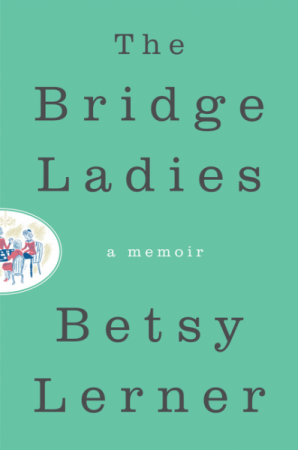
Sally Sparrow, our wonderful editor and Jill of all trades gave me an Advanced Reading Copy (ARC) of a book called The Bridge Ladies, a memoir by Betsy Lerner, published by Harper Collins in May 2016.
This is not a Master Point Press book and it is not really about bridge. But I did find it interesting.
When I was growing up my mom and dad played bridge with their neighbors. I was asleep at the time but my mom tells me that dad was a very good player.
My father (like me) was very competitive and he quit playing when he decided I had surpassed him as a bridge player.
My mom kept on playing. She played with a small group of women who would gather at one of their houses. Each week they would throw some money in a kitty. Half of the money went to the winner but the rest was saved. Eventually mom and her group used the money they had saved for years to go on a cruise.
This book is about a group of ladies who like my mother gathered to play bridge regularly. This tells the story not of their bridge games but of their lives. It is the story of middle class American Jewish women, the mothers of the 50’s and 60’s. It is the story of my mother too.
Betsy has a nice way with words and I enjoyed reading about these women. Now I can picture my mom and her friends from an adult perspective.
I did go to a few of my mom’s bridge games some years ago. It was held in the home of an wealthy widow on Toronto’s ritzy Bridal Path. I remember trying to explain how to play xxx opposite AJ9. I remember trying to convince them not to hop up with the ace when declarer led to KJx. You get the idea.
But I never really knew their stories. This book gave me an insight into a similar group of ladies.
Don’t expect a “bridge book” but this is still a book with a lot to say about a group of ladies in a certain time and place.
May 25th, 2016 ~ linda ~
No Comments
There were only three teams entered in the Canadian Women’s Team Championship. It would probably worth discussing why there were only three teams but that is for another time.
After playing some matches one team was eliminated and the two remaining teams played an eight segment final, each segment being 15 boards.
The two remaining teams were
Eaton: Joan Eaton, Karen Cumpstone, Katie Thorpe, Sandra Blank, Lesley Thomson, Ina Demme
Summers: Sylvia Summers, Barbara Saltsman, Pamela Nisbet, Brenda Bryant, Hazel Wolpert, Linda Wynston.
At the start of the eighth and last segment the score was 207 for the Eaton team and 205 for the Summers team.
I would normally say that the first two boards were uneventful as only one imp changed hand but in this match in this match an imp was an imp!
The third board brought a 10 imp swing to the Summers team but on the next three boards Eaton whittled away at that and by board 23 the score was tied… 216 to 216.
Here are the East West hands
In the Open Room Pamela Nesbit was West for the Summers team and Hazel Wolpert was East. Do you want to be in 6♦ East-West as Nesbit-Wolpert were (no doubt played from the East hand)? There are probably twelve tricks there but you will have to survive a heart lead.
Not a bad contract and one which made on a trump lead (the ♥ Q was onside) so a heart guess was not required.
In the Closed Room Katie Thorpe sitting West pretty much insisted on a spade contract and played in the spade game.
At the start of board 25 of the Summers team led by 16 imps 216 to 232.
On Board 25 Wolpert had this lead problem
There is something to be said for a spade lead, nobody bid spades and the 1095 is not a bad holding to lead from (lets call this a passive lead). You could lead a heart (not my choice into the heart bidder). If you do you will have to decide which one to lead. Perhaps the advantage of a top heart is that North may well only have a couple of hearts and if she has say the 10x or Jx a high heart may work out better. Still not my choice.
I probably would not lead a club finding that a bit too passive. What about a diamond from QJ7 that could be the one?
We can argue the merits of each lead (and Ray and I did) but if you found a diamond you are a winner, not just of this hand but of the whole event.
Before we look at the whole hand lets see what happened at the other table. This was the auction in the Closed Room.
At this table Summers patterned out and bid both her suits. Once Summers made that bid North-South was in a big hole. Bryant probed with 2♦ which gave Thorpe who held
the chance to double for a diamond lead. North-South took what they thought was their only chance for game and bid 5♣. But as it turns out a diamond lead beats both games, 3NT and 5♣.
The whole deal
Do you look Bryant’s 3 ♦ bid? Was she being “too scientific”? You decide.
Still after this board Summers had a 6 imp lead.
Summers arrived at Board 27 still up by 6. Four boards to go, I will tell you that the last three boards were pushes so Eaton had to win at least 7 imps on Board 27 to win the event.
On Board 27 both South’s arrived in 1NT on the same auction (East-West passing throughout). South opened with 1♣ and the auction continued 1♥ by North and 1NT by South.
And as it turned out it would be the lead that would decide the winner of the Canadian Women’s Team Championship. What would you have led?
Remember that 1 imp we were trying to find. You will find it and more on this hand if you lead the right card. In fact you are 50-50. Either major suit lead will defeat the contract two tricks and either minor suit lead will lead to ten tricks for declarer.
To win the match Eaton needed 7 imps or more. This board 1NT making 4 for 180 and 1NT down 2 for minus 100 produced exactly that number.
Congratulations to the Eaton team and my condolences to Summers.
May 11th, 2016 ~ linda ~
1 Comment
A long time ago when I was in high school I learned to play bridge and my main partner was the boy next door, Mark Cosman. Mark who I have seen rarely recently told me a few years ago his son now plays bridge. I hope he still does.
Mark and I learned to play bridge using Charles Goren’s Point Count Bidding. It does seem kind of quaint now. We played for hours with some other fellows from the neighborhood. In those days bridge clubs were definitely populated by young males.
An opening bid had at least 13 high card points. High card points being counted as today. Distribution points were counted for short suits, 1,2 and 3 for doubleton, singleton and void (when considering suit contracts.)
Over the years I learned to open lighter hands .. because there is an advantage to opening the bidding. But we still taught students that you needed at least 13 points, high cards and distribution together. Instead of counting shortness students in recent years were generally taught to count length points for suits longer than four cards. The results were similar.
So now I come to the US team trials and see this hand. In second chair with everyone not vulnerable both Moss and Meckstroth opened this hand 1♦. Would you?
Pluses: You have two and a half quick tricks. Aces are worth more than four points. You are not 4-3-3-3. You have good diamond spots. And all your high cards are in your longer suits
Minuses: You don’t have a long suit. You don’t have much distribution. You only have 10 high card points … okay maybe 11 is you want to count AQ as seven or six and a half.
I was thinking about whether there is a difference in choosing to open this hand in first chair or second chair. I can’t come up with a reason why it would make a difference.
Anyways both Meckstroth and Moss opened it 1♦ . In checking the other tables playing in the team trials there were some that opened and quite a few that didn’t.
Opening the bidding is obviously an advantage but as the required values go down, the spread (the most and least opener can have) becomes greater which is a disadvantage.
Most players change the values required to open by seat opening lighter hands in third chair. In third chair there are many other considerations too .. desired opening lead being one.
Fourth chair? Partner is a passed hand (and passing for some pairs seems to show bird poo). So I think most players would probably not reduce opening bid requirements much.
How likely are you to make this game? First there is a chance of a heart ruff if hearts are 4-1. This is not inconsiderable because if hearts are 4-1 there is a good chance that the long heart hand can get the lead (whoever has the spade ace) and give partner a ruff. You also have to pick up spades for one loser. Sometimes you can’t and sometimes you have to guess (for example, is the spade jack doubleton offside or third onside?) Definitely a good game vulnerable but not quite so clear not vulnerable.
What happens next? At the Meckwell table the pair got to four spades after Rodwell responded 1♠ and Meckstroth showed a minimum balanced hand with three card spade support. With everything friendly the game was a make.
In the other room a curious thing happened South also opened 1♦ (which just shows how old fashioned I am) but this time West, Weinstein, doubled on the balanced 14 count. Grue passed awaiting developments and now it was up to East Levin. With a four count and five good diamonds he decided to tough it out. When Moss also passed he found himself playing 1♦ doubled on the 4-1. With the good diamond spots and things breaking North-South can make six tricks in diamonds for one down.
As I sit and look at the deal now I wonder if I would have passed 1♦ doubled on Grue’s hand? I guess he can defend most things but there was just that danger that the East might have a diamond stack. What do you think?
With the spade AJx onside and no bad distribution 4S was made… sometimes bridge is an easy game. 11 imps to the Nickell team who at the end of the segment had narrowed Fleisher’s lead to just 6 imps (103-109) at the halfway mark of the match.
September 28th, 2015 ~ linda ~
12 Comments
Quite a while ago Ray and I played in a number of tournaments in Florida. This seemed to be the home of many “minor” pros. These pros were good players but not really stars and when they played against us we were pretty evenly matched. They also had to contend with their client at the other table. Sometimes to get an edge they would use what I can only call “sharp practices”. This is in a way a kind of cheating.
One of their favorites was to come to the table very late to make us nervous. Our tactics to deal with that was to wait till they arrived and then have one of us say that we had to go to the bathroom. We played quickly and this tactic evened things out.
We also became aware of local players who decided to play pro and then later were caught cheating. Playing pro put enough pressure on them that they went from ethical players to cheaters. In fact in the days where pros were not really allowed, one of the arguments for keeping bridge “amateur” was to prevent sharp practices and cheating. It would ruin the game.
And now as we find that quite a few pro players are likely cheating I wonder if it really hasn’t had a terrible effect on the game.
I love watching great players find incredible plays and somehow make just the right bid on a challenging hand. Now I wonder if they did this as a result of skill or if they are cheaters.
So many things have already been done to prevent cheating. Forbidding electronic equipment, screens, writing notes to opponents to explain bids, having monitors walk you to the bathroom and so on. But in the end no matter what the organizers do if you want to cheat badly enough than you can find a way.
Is the big money pro-client system the problem? There was cheating before and there is cheating in club games and probably even in home games. But maybe the big money provides more of an incentive.
The only answer I can think of is to be ready to have some experts on hand who look for pairs who are getting results that are too good, too precise, too many good guesses. Be alert for cheating and expect it in even the best bridge players.
This just seems too sad to me. For me bridge is “the beautiful game.” It is so sad to see it sullied.
February 18th, 2015 ~ linda ~
6 Comments
I am working on a talk on sports psychology. It has three parts to represent the three activities I participate in: Bridge, Running and Tennis. My expertise in each of them is in that order. I consider myself a bridge expert, a running advanced and an intermediate tennis player (although some might argue that I am being too generous in the latter two designations.)
What I have noticed is that many of the psychological issues are consistent in all three of these activities.
The first one may be called things like pregame jitters or performance anxiety or stage fright. It is the feelings you get when you are waiting to begin an important match. These are based on the human “flight or flee” response. In short when humans feel “threatened”, the pitituary gland secrets ACTH and the adrenal gland secretes epinephrine. This is to prime you to either face the enemy or run away (Fight or flee). The body releases glucose and also starts the production of addition energy to prepare muscles for action. Blood is diverted to the muscles, and all parts of your body work to supply extra energy.The heart beats faster, you breath faster, you may start to shake, and so on.
In sports (and here bridge is a sport) performance anxiety is often worse when the game seems important. It may relate to having an audience (you should have seen me play when I was first on Vugraph or on the Internet – no its best not to!).
If the bridge player lacks confidence than it will be tough for self talk or other similar techniques to help them to do their best. I remember once when I was playing in the World Championships I met Bob Hamman in the elevator. We were in the quarterfinals I think and I was nervous because we were up against a good team. Bob told me that they put their pants on one foot at a time to reassure me. I have never forgotten his attempt at relaxing me but it really didn’t help. I knew they were better than our team.
Instead of fighting the pregame jitters, better advice is probably to accept it as normal and as part of the natural preparation for competition. Once the game starts you feel better. I think we all have pregame routines. What I have learned in all the games/sports I play is that the pregame routine can calm me and get me ready for the start. Other ideas might be using positive self-talk. “I am going to do my best.”, to smile and try to separate the outcome from just bidding and playing each hand.
Self Talk
Most people have running dialogues with themselves. If you have make a bad bid or play do you shoot yourself down? (I do!) The goal is to replace negative messages with positive ones. “I am going to figure out the right line of play.”
One thing that I do when I run and play tennis is use mantras: short positive statements that are encouraging or provide focus.” In tennis I use one word: “Ball” to remind myself to focus on the ball. In bridge I might use the one word on play: “Count” to remind myself to work and count out the hand. In running as I get tired I use: “You can do it!”
December 13th, 2014 ~ linda ~
No Comments

For December all of Linda and Ray’s Holiday Gift Picks will be on sale for 20% off at ebooksbridge.com. To see a full listing of ebooks on sale visit ebooksbridge.com or
our informative blog post on BridgeBlogging.com.
In the early days of Master Point Press, Ray put together a writing team for a book that he and I conceived. It all began with frequent phone calls from my mother who was an avid social bridge player.
Each phone call would go something like this:
“I opened 1♠ and my partner bid 2NT (Jacoby); I have 18 points with no shortness,”
“Yes, mom.”
“Well what do I do?”
“Do you know the responses to Jacoby?”
“Some of them, but not that one.”
And the conversation would continue with me walking through the responses to Jacoby 2NT.
Sometimes one of the “girls” who played at the local bridge club would bring new conventions or new ideas about responses or continuations to my mom’s home game, and I would be called to make sure they were on the right track.
After a while it became clear that my mom and her circle really could use a book that would teach them about bridge conventions in a more in-depth way, explaining the purpose of the convention, the responses and continuations so that they could use them effectively.
 I didn’t write the book — Barbara Seagram and Marc Smith did. I didn’t edit the book, my husband Ray did. But if I could I would have dedicated the book to my mother who was the inspiration for 25 Conventions You Should Know.
The book was very well executed. Ray, who had a background in educational publishing, suggested some of the features for the book: chapter summaries, examples, quizzes for the readers and little asides called “By the Way”. The book explained each convention, the various responses and the continuations. Eddie Kantar, whom we asked to contribute a foreword, wrote, ‘The reader who knows nothing or next to nothing about the convention being explained will leave the chapter thinking he or she can play the convention. It doesn’t get any better than that.
The book was beautifully designed by Olena Sullivan, with special attention to the cover – we wanted that to be bright and eye catching.
Everything worked out to create a prize-winning book (ABTA Book of the Year) that has gone on to be perhaps the bestselling bridge book of the last 50 years. Sales have gone well over 200,000 copies in English, and 25 Conventions You Should Know has been translated into several other languages. It is one of the few bridge books reviewed on GoodReads (the premier book rating website), getting a top rating from nearly all the many reviewers.
So thank you, mom, for providing the inspiration for this wonderful book. As one of the reviewers on GoodReads said, “If you play bridge – you’ll love this book!”
And so I am going to give this book to my friend Victoria. She used to play bridge many years ago and now that she is coming back to it again this book will help her to learn the more sophisticated bidding methods of today. Welcome back to bridge, Victoria.
December 11th, 2014 ~ linda ~
2 Comments
For December all of Linda and Ray’s Holiday Gift Picks will be on sale for 20% off at ebooksbridge.com. To see a full listing of ebooks on sale visit ebooksbridge.com or
our informative blog post on BridgeBlogging.com.
 I remember the day I first saw the manuscript that eventually became There Must be a Way – the second book MPP ever published. It was a handwritten collection of bridge problems by a Toronto bridge player named Andrew Diosy – someone I didn’t know, despite the fact that I thought I knew all the good players in the area. Andrew, it turned out, was a medical doctor who had moved to Canada after the Hungarian uprising in 1956.
Ray asked me to turn the manuscript into a book, and I accepted the challenge happily. I loved Andrew’s problems. They were different from any I had seen before. They required you to think about the hands in new and interesting ways — practical ways too. The play was always logical but it did require lateral thinking and the use of the creative part of your brain. The solutions needed deeper thought, some consideration of the moves you could make and also of your opponents’ countermoves. Often the solution was quite simple (and always elegant) – just hard to spot.
So we devised a new format to present them. (I was flattered some years later when master problem creator Julian Pottage used the same format for two of his books.)
It occurred to me that what Andrew had created were not specifically declarer play or defense problems, but problems in analysis – can you make this hand, or should the defenders find a way to beat you? We decided to start by showing the reader each problem double-dummy, with the title of the problem providing a small hint to the solution. Then when you were ready, you could turn the page and see a discussion of the play and its issues, and often a hint or two. You were asked to think about it again before looking at the full solution which appeared later in the book.
I felt as I worked on the hands that the process was making me a better declarer. And I liked so many of the hands. Even then I knew that this book was a great gift for people who, like me, loved cardplay or for those who wanted to improve their ability to think deeply about a deal.
I wrote the book in Florida that winter. My parents were living in a condo a few floors below but I was basically there by myself, working in the morning and enjoying the Florida sunshine the rest of the day while Ray was home in the cold. I was punished for my happiness when I was given a work assignment in my real-life role as a computer consultant which required me to travel to Calgary and Edmonton and the -30 degree weather. My first stop in Calgary was at a store where I bought the wooliest gloves, hat and scarf I could find!
Here’s a typical problem from the book. It’s entitled
Belladonna’s Class
Contract: 4♥
Lead: ♣ Q
Well, can 4hx be made on best defense? Try it for yourself before scrolling down to the two parts of the solution.
Solution Part 1
The problem on this hand is to avoid losing three diamond tricks: there is an inevitable trump loser so the diamond losers must be held to two. After winning the first trick with the ♣A, you must defer drawing trumps so that you can ruff a diamond if necessary. You start by leading a diamond to the nine: West must duck and East will win the ♦10. East will not return a trump, and it doesn’t matter whether you rise or duck, the defense will have an opportunity to remove dummy’s trumps, either immediately or when West gets in on the ♦A.
Is there a way to make this hand?
Solution Part 2
This hand can be made. The problem is to avoid losing three diamond tricks. The instinctive play is to lead a diamond from the closed hand towards dummy and finesse the ♦9 when West plays low, but that does not work on this hand. The key is to make sure that West wins the first diamond, and to do this you cross to dummy on the ♠A and lead the ♦9.
East cannot afford to rise on the ♦K because this will allow you to set up a diamond trick by force. The best East can do is to cover the ♦9 with the ♦10, but you counter by playing the ♦Q. West wins with the ♦A, but he cannot play trumps without losing the defense’s trump trick. Suppose West continues a club: you ruff in hand and lead another diamond, East’s king winning. When he returns a trump, you go up with the ace and ruff your third diamond in dummy.
 There is a story to this hand: when it occurred many years ago in a rubber bridge game, the great Italian star Giorgio Belladonna picked the winning line after hardly a moment’s thought!
I am going to give this book to my old friend Mike. He loves to play dummy. He is good at it but I know he will be a better declarer after reading this book. And next year I can give him the sequel, You Have to See This.



 Subscribe to our feed
 Bridge-related