August 29th, 2008 ~ linda ~
No Comments 
Finally Colin had time to play with me again. I knew it if I played with Colin:
a) it would be a lot of fun
b) weird things would happen
c) imaginative bids and plays would happen
d) we would have some cool system discussion
Did it all happen? Oh yes.
Early on I got to play in 1NT doubled making a couple of overtricks. I mention this because the system we play over our weak notrump allows us to play in a spot. I opened 1NT in third and LHO doubled.
Colin held S 975 H KQ87 D 65 C K742.
I suppose he could have redoubled for penalty in a "Guoba" based system. Would you do that playing 12-14 notrump? It does make the stakes awfully high. In our system Colin could simply pass saying that was where he wanted to play it, making it an easy decision.
Like many other hands later the hand was fun (to play). meeting a)
It took only to board 4 when Colin did something out of system. This was what he held. S 63 H Q1094 D AQ975 C AK
Playing standard I opened 1S and Colin bid 2D. When I bid 2H Colin couldn’t bid 3H (not forcing) and he really did like his hand. So he bid 4C a splinter. Imaginative!
I held S AQ984 H AJ876 D 10 C 108 and decided not to make a move with the singleton diamond. So we ended in a normal 4H anyway. As it turns out the cards are perfect and you can make 6H. Criteria c had been met.
On board 10 Colin mesmerized his RHO although it was only for an overtrick. He opened 4S vulnerable. The opening lead was the HK. Here was my hand
S Q3 H A64 D A C KQ87643
Colin’s RHO held S 8 H J985 D Q1087 C AJ95
Colin won the HA in dummy and cashed the DA and the lead a small club from the table. RHO thought for a while and put in the C5 allowing Colin to win his singleton 10.
Colin held S AJ1097642 H 104 D K5 C 10
I wouldn’t have thought of that sequence of plays. Now is that weird or imaginative – I call it weird, criteria c)
Here is an amazing disaster hand that did lead to a bit of system discussion. I held S 98542 H Q104 D AJ5 C 74.
We were vulnerable against not and West passed, as did I. East opened 1S and Colin bid 2S. West passed. What should I bid? I wasn’t sure what 2NT would be. If he had diamonds I surely wanted to be in 4H and even if he had clubs I thought I might have enough to invite in hearts. But we had not discussed this sequence. I decided to make the aggressive bid of 4H. South now bid 4S. This was Colin’s hand.
S void H AJ875 D Q C KQJ10652
If he bids 5C I think that should be natural and show better clubs than hearts. Anyway he bid 4S and I bid 5H. When West doubled this Colin sent it back. Unfortunately this is doomed to go 2 down on a spade lead with the bad heart break (4-1 offside). Since 2 down redoubled didn’t seem like a good score I played to make it and went 4 down. I seem to remember some slogan about -1100 being character building. -2200 is double that.
Anyway, criteria d) had been fulfilled.
August 28th, 2008 ~ linda ~
No Comments
There is so much great stuff on the web that I decided to see if I could find one thing each day that would help me to be a better bridge player. Here is my challenge. Each day I must find something that I believe will really help me and/or my partnerships to improve and each one must be different. I will report back my adventures. I am always happy for suggestions if you want to help me along.
I will of course also report any misadventures or false steps along the way.
Day 1
My first stop was the playBridge Hand Generator at www.playbridge.com. I actually do have Dealmaster Pro. Dealmaster Pro (www.dealmaster.com) is much more flexible but the playBridge Hand Generator is free and looks like a good fast way to create a few practice hands to bid. It has the basic constraints you would want, allowing you to control suit length and high card points. They could make it better by adding definitions, like a weak 2 bid or a one spade bid, allowing combinations of suits either spades or hearts are 5 cards long etc. I do like one feature. You can deal hands with specific target cards in a hand. For example, you can say that you want north to have the SA and the HA.
Deal generators are good not just to deal out hands but to test ideas but bidding and play. You can deal out hundreds of hands and analyze which approach works best. I remember Paul Heitner talked to me about this idea 20 years ago. (Paul, known as the Whale, died too young, was editor of Bridge Journal and a fine bridge player.)
I followed a link from Playbridge and found David Stevenson’s page http://www.blakjak.demon.co.uk/index.htm and saw a page on bridge laws. The laws have recently changed so I thought I would take a look. A lot of it seems a bit old but the heading psyche articles catches my attention. I don’t know why I find pysches fascinating. I never make them but I know, in my heart, I want to sometimes. There is an interesting idea here about pysches and false cards. http://www.blakjak.demon.co.uk/flse_cds.htm.
The author Robin Barker points out that if partnership know that they will use false cards in a number of positions then they have an agreement and really should disclose it to the opponents. There is some truth to this but however would you do it. I have thought before that carding is an area of very poor disclosure. His links to the updated laws don’t work so I do my own searching but before I go I can’t resist a few of Robin’s humour links first. I love the Edgar Kaplan quotes. Try this link to for even more of Edgar: http://members.tripod.com/~sarant_2/bridge/kapnuggets.htms.
Here are a few Edgar items
| The Canadians made dubious penalty doubles at both tables (dubious by my standards, but I double fewer voluntarily bid games than most -I figure that good opponents, looking at their cards, may know what they are doing).This led to a huge swing after Sutherlin’s courageous four-spade bid (…) (I would have used a different adjective had he taken a painful penalty).I’ve never understood why they say that down one is good bridge. [after a partscore went one down; with the same cards, Meckstroth made 3NT+1] Making an overtrick –that’s good bridge. |
I found the 2007 laws at this location.http://www.worldbridge.org/departments/laws/2007LawsComplete.pdf
The first thing I noticed was that it had 69 pages which seemed like an awful lot. Couldn’t they just list what had changed. Right up front I see the definition of a psychic call. I remember an argument on BBO about whether random bids over 1C are psychic. It is defined as a deliberate and gross misstatement of honor strength and/or suit length. I think that does mean that random bids over 1C are indeed psychic.
Things I didn’t know but aren’t very useful
a player could request a cut of the pack after the shuffle.
you have to look at your cards before bidding
Useful things I should have known
During the auction any player can draw attention to an irregularity even if it isn’t his turn
Dummy isn’t allowed to draw attention to an irregularity until the end of play but may attempt to prevent a player’s committing an irregularity.
If you can’t play the board the best result that can be awarded (if you are not at fault) is average plus (60%) and the worst average minus (40%) (normally plus or minus 3 imps)
A logical alternative action is one that among the class of player and using the methods of that partnership would be given serious consideration by a significant proportion of such players and some might select it.
you can ask for an explanation of a bid throughout the card play (at your turn)
Okay, I made it to page 20. It is kind of interesting but I am not sure it is really making me a better player. I will bookmark it and read more if I am having trouble sleeping.
I am at a bit of a dead end and so I decide to google bridge movies. I wind up at Jeff Goldsmith’s Home Page.
http://www.gg.caltech.edu/~jeff/
Lots of interesting stuff here . I try a couple of hands in the KR evaluator (Kaplan- Rubens) and it seems to do a good job of evaluating distributional hands (well, I agree with it anyhow).
The bridge movies and problems … finally the meat.
I am playing matchpoints… can’t be good. Here is the first hand decision:
You have S A98765 H K D AQ105 C J2
Partner opens 1H and you bid 1S (which shows 5 in your methods – you play Flannery). Now partner bids 1NT shows 12-15. You can bid 2D an artificial inquiry, 3S forcing, 3NT or 4S.
This is matchpoints so I think 3NT is an easy call. It could be right at any scoring.
I push the button and find out I have got 80% on that board. Maybe I do like matchpoints.
This is definitely a lot of fun. (There are other types of movies and problems too). I am going to get Ray to try this out and get into a matchpoint mood before Sydney.
Going through the entire bridge movie taught me a number of interesting bidding ideas for matchpoints. I have learned something!
August 28th, 2008 ~ linda ~
No Comments
I may once have caught a glimpse of Bill Gates playing at a bridge tournament. I was playing a match and someone pointed him out. However I was too focused on the deal I was declaring to really notice.
I was reading Jonathan Ferguson’s BLOG about seeing Bill Gates and introducing himself at a vendor table and then noticing Bill and Warren Buffett leaving the playing area. It’s interesting that they can feel so at home at a bridge tournament. I wouldn’t have introduced myself though. What did you say, Jonathan? I would have no idea what to talk about. (Tips on the market perhaps? Should I sell all my US dollars? How’s oil going to do in the next year?)
I am never in awe of bridge celebrities. I once even talked to Bob Hamman. He told me not to worry about my next match – my opponents (women) put on their pantsuits one leg at a time or something like that. It was kind of sweet. I have had my picture taken with my girlfriend Margaret Lerner and Zia. Allan Sontag (author of one of favourite ever bridge books – The Bridge Bum) sometimes murmurs hello as he rushes by.
At the table, I never pay any attention to who my opponents are. Once I was playing against Zia and I could have taken the setting trick in 1NT doubled (vulnerable) and I didn’t cash it. I knew he would go wrong and assume I didn’t have the thirteenth heart and take finesse into my hand for two down.
But, Bill Gates and Warren Buffett do impress me. It isn’t just the incredible amount of money they control but that they built empires and became wealthy all by themselves. So I am impressed.
So Jonathan, next time we are together at the nationals, could you introduce me to your buddy, Bill Gates.
August 27th, 2008 ~ linda ~
No Comments
I know I mentioned that I love to read old Bridge World magazines. Every time I pick one up I find something interesting. It usually only takes a minute or two. Well taking a short break I picked up the July 1987 edition. The magazine magically flipped open to Page 24. The article described a playoff in the semifinal of the U.S. team trial written up by Phillip Alder. Bobby Wolff (a friend and author) was playing with Bob Hamman at one table against Solway and Goldman. At the other table their teammates Martel and Stansby were playing against Andersen and Lair. Here was a critical hand which brought the match to within 1 imp.
Try bidding this with your favourite partner. Ray and I bid it and I will give you our results, the match result and some thought a bit later on.
West (dealer) noone vulnerable
West S AKJ7543 H J106 D 2 C A8
………………………….. East hand coming up …………….
East S 6 H AK87543 D AKJ C J6
At the table Stansby opened 4D Namyats. Here was their auction.
Stansby Martel
4D 5C
5NT 6C
6S
Over 4D showing 8-9 tricks with spades as trump, Martel bid 5C. I don’t know what they were playing but based on the hand and the rest of the auction it must have showed red suit controls and denied a club control. Stansby bid 5NT Grand Slam force and when Martel bid 6S settled for the small slam knowing they were off the trump queen.
Ray and I play Namyats too and if Ray had bid it the auction would have gone 5D showing both diamond and heart controls, no club control and slam interest and we might have had the same auction. But Ray didn’t see Martel’s hand as a Namyats hand. He didn’t think it had enough playing strength in spades, interesting.
At the other table Goldman and Solway had a rather unscientific auction which landed in the right spot.
Goldman Solway
1S 2H
3S 4D
4NT 5H
6H 7H
Solway’s 4D was a cuebid in support of spades and Goldman’s 6H was a choice of slam. Solway bid 7H because if Goldman had heart support his hand had improved and he took a chance that they weren’t off an ace.
Ray and I had this auction but remember I did know what his hand was. I tried not to cheat. Here goes
Ray Linda
1S 2H (not Game force)
3S 4H (very good hearts)
4NT 5D (0 or 3)
5S 6D (I think 7 is enough extra in this auction to count as the queen)
7H
The problem with our auction is that 4H is an underbid. Maybe I should bid 5H but will that get us to seven? The problem is that with seven good spades partner tends to set that as trump and it is hard to get to another strain. I rather like the Goldman-Solway auction even if there was a bit of guessing at the end.
The results of the match: the team with Hamman Solway Martel and Stansby won by 1 imp. This was the second last hand and this hand brought the teams to that score. However the last board was flat.
Winning by 1 imp is a lot better than losing by 1 imp.
Here is the New York Times story written by Alan Truscott which describes the trials and you can find out who won by following the link.
http://query.nytimes.com/gst/fullpage.html?res=9B0DE1D71630F93AA25756C0A961948260
August 26th, 2008 ~ linda ~
No Comments
Hubby Ray had some thoughts on this subject and he brought up an idea I had forgotten about. Several of Canada’s best women players play mostly Open Events. Judy Gartangis, May Paul and Sandra Fraser have great track records in the CNTC.
Here is how they have done:
| |
2001 |
2002 |
2005 |
2006 |
2007 |
2008 |
| Sandra |
|
|
2 |
1 |
2 (CWTC) |
2 |
| Judy |
1 |
3-4 |
3-4 |
5-8 |
2 |
5-8 |
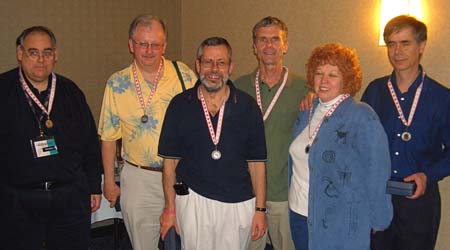
Sandra Fraser with the silver medal team 2008

Judy, silver medalist 2007
Mary has been a bit less active lately but her record is outstanding and I can vouch for the fact that she is  an excellent player and a fierce competitor.
Mary Paul won the first ever CNTC in 1977 and subsequently won it again in 1993. She placed third in the 1989 Venice Cup, third in the women’s olympiad in 1988, 5th in the Swiss Plate in 1984, 6th in the world senior pairs in Montreal in 2002. and won many CWTC and represented Canada many times from 1968 to 1997. She is author of Partnership Bidding, a Masterpoint Press book designed to help you establish agreements with your partner.
I am sure I am missing many of her achievements.
August 26th, 2008 ~ linda ~
No Comments
Ray and I got a few hands in on BBO tonight. Most of it went very well. Here is an interesting hand. I am going to give you a hypothetical first. Ray opened 1C and with all vulnerable East bid 3S. I held
S void H J92 D AKQ10763 C KJ3
I bid 4D, not completely sure how to find out what I needed to know. Let’s say East bids 4S and it goes pass, pass to you. What bid would you make? I have no idea what to do.
Let me think about what I know. Since we play weak notrump, Ray almost certainly has an unbalanced hand. I suppose it is possible that he has a strong notrump but he almost certainly would have doubled or bid something. He probably doesn’t have too many spades. Can I think of a hand where we can’t make a slam? Let me see.
S Kxx H QXXX D void C AQXXXX
Yes that one will do but I still have good chances if they don’t lead a heart. 6C would be best on this particular hand.
Maybe over 4S the best bid is 6C. What do you think?
Anyway it didn’t happen. West passed and Ray bid 4H. The auction suggested Ray had 5C and 4H but it wasn’t certain since if he was balanced and had no spade stopper he had to bid something. However, as Ray later point out if her had no cards in spades and a strong notrump we were too low since there are only 16 points missing in the other suits so we have no holes.
But the auction did suggest that he didn’t have much in spades so I shot 6D, Maybe 6C would have been better but he would never guess what I had and I don’t know any way in an auction like this to say — much better diamonds partner but I do have a club fit.
Whatever I did turned out to be fine. He held S53 H AQ104 D 84 C AQ942 and yes seven is cold if there is no ruff. I would be interested in a sensible auction that gets you to seven.
Would you have bid on West’s hand. He held SKJ72 H 765 D J52 C 1065. It is a pretty lousy hand even with 4 trump.
I was reading an article in an old Bridge World yesterday. I confess I read parts of old Bridge Worlds all the time. They get better with age, like some wines. It was talking about luck and bridge. One idea suggested was that some players are better defenders or better at bidding slams or whatever and you want them in when the right hands come up their way. Its the luck of the draw. Anyway, I think I am good at bidding slams. I remember the match against England in Shanghai. Our team badly needed a big win. Pamela and I bid three slams against them and blitzed them. There was no other pair in the field to do that and I shall always be proud that we did that.
I know my bidding weakness but I am not telling.
August 25th, 2008 ~ linda ~
1 Comment
I like to go onto BBO now and again and play a few hands with whoever happens along. Sometimes I play in a baby game and sometimes I try for a tougher game although I find it can still be pretty random.
Today I was playing with someone labelled A player. Not much was written on his profile except that he he was an expert. I have played in games with him before but I don’t think I know who he is. Here is a hand we played. The only discussion was 2/1.
A player held:
S A642 H A32 D void C AKQ1075
He opened 1C with this nice hand and South overcalled 1H. I bid 2D and a player bid 2S. Here is what happened next:
| Me |
North |
A player |
South |
| |
|
1C |
1H |
| 2D |
pass |
2S |
pass |
| 3C |
pass |
3H |
DBL |
| 3NT |
pass |
? |
|
| |
|
|
|
Although 3NT looked like a decent contract on the auction A player was not giving up on a slam. Despite wasted diamond cards slam still looked very good. He bid 4C. I cuebid 4D and a player bid 4H. When I cuebid 4S he jumped to the club slam with 6C.
Here is my hand. You will notice I bid a lot but I liked my hand more and more as a player bid.
I held S K3 H K7 D A97632 C 962
As it turned out the lie of the cards was friendly and 7C made. I commented after that it was a very good auction for strangers. The short discussion afterwards indicated that a player was not a stranger. But just as he was going to tell me who he was he had to leave. He promised to tell me next time. Isn’t that intriguing. Now if you all know who A stranger is don’t tell. It’s too much fun this way.
August 22nd, 2008 ~ linda ~
7 Comments
A while back I was thinking about some of the great players in Canadian bridge. I think Canada has developed an amazing number of really talented players, many unfortunately have been part of a bridge brain drain to the USA. Nick Krnjevic from Montreal did send in a great suggestion, Sharyn Reus. Sharyn is not only a great player but she is one of those lovely ladies that you really enjoy having on your team. I am so glad that she came out of retirement to play bridge again.
I could write a lot about Sharyn’s successes. She along with my other teammates Francine Cimon and Diana Diana joined by other great players like Rhoda Habert Katie Thorpe, Mary Paul, Joan Eaton and others are part of a great bridge dynasty that has had success on the world stage for many years.
I would be interested in any additions or ideas you might have. Add a comment or send me an email. What about the best open player? Who is our greatest current player? I think Jeff Hampson might be my pick if we can count players who no longer play for Canada. Perhaps we should pick a partnership rather than a single player.
Speaking of Canadian success it was amazing how very well Canadian has done in these Olympics after such a slow start. I know that we are sending out best wishes with our bridge teams that will represent us at the World Mind Games.
August 21st, 2008 ~ linda ~
4 Comments
The Lee’s are playing Multi 2D to show a weak 2 bid in a major. The systems I have played in the past over this have some problems. I couldn’t find much on the web so we have started to explore some strategies for improvements.
One problem we came up across was how to handle the auction:
2D-2H-2S
Hearing partner has spades you want to make a game try while with hearts you weren’t interested.
This was relatively easy to fix with some system. We decided that 2NT asked for a feature (as over 2S) but partner could just bid 4S with good trump and a decent hand.
I have also found a number of problems when responder has an invitational hand or a strong two suiter with the other major. In most systems
2D-3m is NAT and forcing one round so I suppose you could start with 3m on the latter hand.
Anyway, we are now trying out 2D-3C showing the at least 5 hearts and at least invitational values and 2D-3D showing the same thing with spades. We have been developing auction continuations. It seems to work fairly well since these hands are much more frequent than a hand where you want to make a forcing bid in a minor. However Colin did come out with one bizarre hand over 2D. He had S – void H 5 D AQ1092 C AKQ10987 and over 2D he just punted 6C. We did agree that 5NT would have been pick a minor but on this type of hand I don’t think that helps.
Anyway, I would be interested if anyone has a system that they really like over multi.
August 21st, 2008 ~ linda ~
No Comments
I was watching a neat hand played in a team match tonight. The bidding on this hand was interesting.
| North Judi Radin |
| S AKJ6 |
| H AJ2 |
| D AQ108 |
| C J3 |
| |
| South Sylvia Moss |
| S Q74 |
| H K4 |
| D KJ92 |
| C A986 |
North Judi Radin opened 2NT. How would you proceed as South. In the Lee system which is being changed rapidly as we speak we bid 3C which is an obselete but still useful bid asking partner to bid four card suits up the line. Here North would respond 3D and South would probe a bit but eventually end in 6D.
But Sylvia Moss had a very compact auction to get to the best spot. 5NT asks partner to bid 4 card suits up the line and 6D got to the best spot in 3 bids. Isabelle and I have a similar system over 4NT and we did talk about doing over 5NT as well. It does work out well on a hand like this, doesn’t it. WIthout the machinery their opponents got to the inferior contract of 6NT and with the heart finesse off couldn’t find 12 tricks.
Here is another hand where their partners shone.
| Mildred Breed |
| S Q103 |
| H A104 |
| D 873 |
| C KJ32 |
| |
| Marinesa |
| S AJ87 |
| H K8532 |
| D void |
| C AQ87 |
| Marinesa |
North |
Mildred |
South |
| |
|
|
2D |
| DBL |
4D |
DBL |
Pass |
| 5D |
DBL |
pass |
pass |
| 5H |
pass |
6C |
all pass |
If you are in slam on these cards 6C is the right spot. This is my interpretation of the auction – not the participants so it could be wrong.
Over 2D Mainesa Letizia doubled. Over 4D Mildred Breed doubled to show a good hand but no clearcut bid (it probably suggested she did not have a four card major). 5D was a a slam try and 5H was for play . Mildred liked her hand enough to want to play in slam but along the way she bid 6C, choice of slams. Neatly done.
In 6C Marinesa had extra chances and was able to make the hand when hearts did not split and the SK was offside. Here is the whole hand
| |
Mildred Breed |
|
| |
S Q103 |
|
| |
H A104 |
|
| |
D 873 |
|
| North |
C KJ32 |
South |
| S K64 |
|
S 952 |
| H Q976 |
|
H J |
| D KQ62 |
|
D AJ10954 |
| C 96 |
|
C 1054 |
| |
Marinesa |
|
| |
S AJ87 |
|
| |
H K8532 |
|
| |
D void |
|
| |
C AQ87 |
|
On a heart lead Marinesa was able to pick the heart suit up with a finesse and a ruff. Here is how the play went. She won the heart lead in hand and played three rounds of trump. She finessed the H10 and then lost the spade finesse but she could still set up the heart suit to make her contract.
As it turns out the hand is touch and go on a diamond lead – this strains declarer’s communication. Suppose that declarer does not find the double dummy line of leading a spade from her hand (which ensures the contract on the lie of the cards). If declarer crosses to dummy on a spade and tries the spade finesse the defenders are likely to prevail if they duck the first spade making communication very difficult for declarer. Otherwise they will have to find the double dummy return of a spade when they are in on the SK. It would have interesting to watch the play on that lead.
Generally the US ladies were in good form. I was impressed.




 Subscribe to our feed
 Bridge-related